Users & Tenants
Evaluate behavior from human API consumers, authenticated clients, partners, and tenants.
Runtime API Governance
Runtime API Governance evaluates API consumer activity while production APIs are in use. You define the policies that Proxyble applies as behavior, risk, context, and resource use change.
Proxyble evaluates behavior and policy while an API consumer uses production APIs
An authenticated service begins using production APIs
Endpoint use and resource impact differ from the API consumer’s prior activity
Behavior, identity, endpoint, and risk inform the policy decision
Proxyble applies the configured action while the production API is in use
Authentication and authorization decide whether an API consumer can access an API. Request inspection and static limits evaluate individual requests or fixed thresholds. Runtime API Governance continues to evaluate how the API consumer behaves after access is granted, then applies policy as behavior changes.
Runtime API Governance evaluates what API consumers do while production APIs are in use, not only who they are or whether one request is valid.
Runtime API Governance evaluates API consumers by behavior, context, and resource impact while production APIs are in use.
Evaluate behavior from human API consumers, authenticated clients, partners, and tenants.
Evaluate internal services, service accounts, partner integrations, and third-party automation.
Evaluate scripts, crawlers, automated clients, retries, and unexpected machine behavior.
Evaluate autonomous agents and AI-driven workflows that act as API consumers.
Evaluate sequences, repetition, request rate, deviations, abuse, and anomalies as patterns develop.
Your policy can use endpoint sensitivity, API consumer scope, risk, and resource consumption to inform policy decisions.
Proxyble observes API consumer behavior, evaluates the behavioral context against policy, makes a policy decision, and enforces the configured action while production APIs are in use.
Proxyble collects available signals from API consumer activity while the production API is in use.
Proxyble evaluates behavior, identity, endpoint, risk, and resource signals against policy.
Your policy determines the action for the API consumer or situation.
Proxyble applies the decision and retains evidence for review and audit.
Proxyble combines continuous governance, behavioral analysis, and adaptive enforcement in one runtime layer.
Continuously evaluate API consumer behavior and make policy decisions while production APIs are in use.
Detect abuse, anomalies, risky behavior, and policy violations across API consumers and services.
Apply the response you configure based on behavior, context, and policy.
Proxyble adds behavioral context and runtime policy enforcement alongside the infrastructure that already handles routing, identity, inspection, and observability.
Human, machine, automated, authenticated, and anonymous
Lifecycle, routing, identity, inspection, and telemetry
Behavioral context and runtime policy enforcement
Live operation and application resources
Evaluate how Proxyble observes behavior, makes policy decisions, enforces actions, and records evidence under defined operating conditions.
See where behavioral evaluation, policy decisions, and enforcement operate in the API path.
Review the identity, endpoint, time, risk, and resource signals Proxyble uses to build behavioral context.
Define policy scopes, exceptions, actions, and the logic that controls them.
Measure outcomes, latency, throughput, and resource impact under defined workloads and configurations.
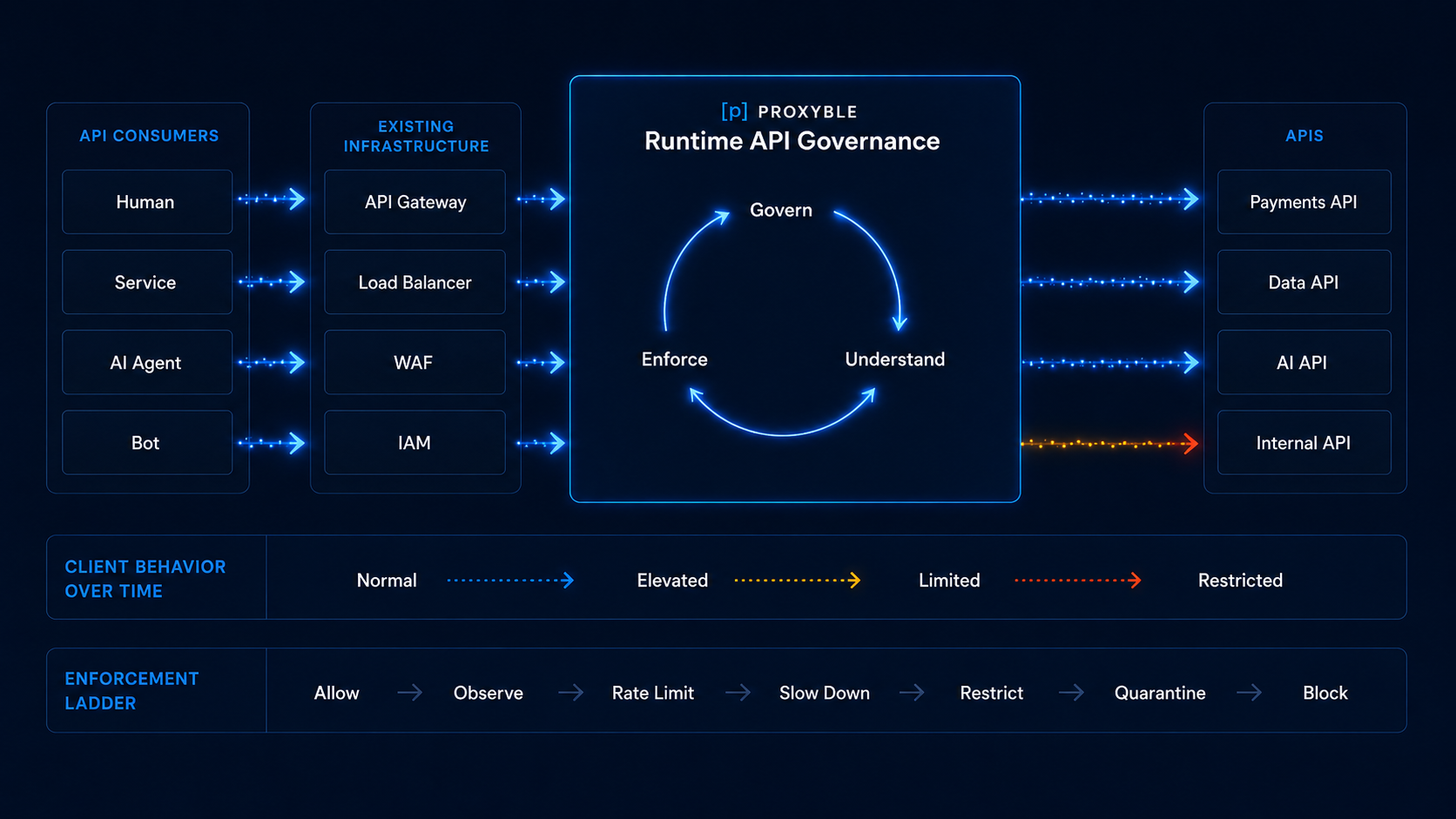
Runtime API Governance evaluates how API consumers behave while production APIs are in use. Proxyble compares the behavior with policy, makes a policy decision, and enforces the configured action as behavior, risk, and operating conditions change.
Runtime means that governance happens while production APIs are actively being used. Runtime API Governance does not only apply during design, deployment, cataloging, or periodic review.
Proxyble observes API consumer behavior, evaluates identity, endpoint, risk, and resource impact in context, makes a policy decision, and enforces the action that you configure.
No. API lifecycle governance focuses on design, standards, catalogs, change management, and API management. Runtime API Governance focuses on API consumer behavior and policy enforcement while production APIs are in use.
No. Runtime API Governance works alongside API gateways, API management platforms, IAM, WAF or WAAP, observability, SIEM, and other existing infrastructure. Proxyble adds runtime behavioral evaluation and enforcement to those controls.
No. Security is a core use case. Runtime API Governance also supports resource protection, consumer fairness, automation reliability, operational resilience, and policy compliance.
No. Monitoring provides behavioral context. Runtime API Governance also makes policy decisions and applies the enforcement actions that you configure while production APIs are in use.
Depending on the policy and risk, enforcement can include alerting, rate limiting, throttling, slowdown, action restrictions, quarantine, temporary bans, or blocking.
Proxyble can process traffic from which it can extract data, including TCP, UDP, HTTP, JSON, and custom protocols.
Proxyble is designed for real-time enforcement and can analyze up to 1,000,000 operations per second. You can also deploy Proxyble as a sidecar to keep added API-path overhead minimal. Actual performance depends on hardware, workload, enabled features, and deployment configuration.
See how Proxyble brings Runtime API Governance, Behavioral API Security, and Adaptive Policy Enforcement together in one runtime control layer.