Why Static Rate Limits Fail for Modern APIs and What Comes After Them
Static rate limits remain useful, but behavioral runtime analysis adds the context needed to understand how API consumers behave and how risk develops over time.

Why Static Rate Limits Fail for Modern APIs and What Comes After Them
Static rate limits remain an important API control, but request count alone cannot describe how a consumer behaves, what resources its requests consume, or how risk develops over time. A behavioral runtime layer adds that context while preserving the predictable boundaries that static limits provide.
The Static Rate-Limit Model
Static rate limiting solves a useful and well-defined problem: controlling how frequently a consumer can send requests to an API.
The basic model is straightforward. Identify a source, client, or authenticated identity; count its requests over a time window; compare that count with a configured threshold; and take an action when the threshold is exceeded. A policy might allow 100 requests per minute per API key, for example. A consumer sending 80 requests remains within the limit. A consumer sending 120 does not.
identity + request count + time window + threshold
That simplification makes static rate limits practical. They can enforce predictable quotas between consumers, prevent one consumer from taking a disproportionate share of capacity, absorb accidental request bursts, and provide basic protection against resource exhaustion. When operational impact correlates closely with request volume, request rate is an effective signal.
The limitation appears when rate stops being a good proxy for behavior or resource impact.
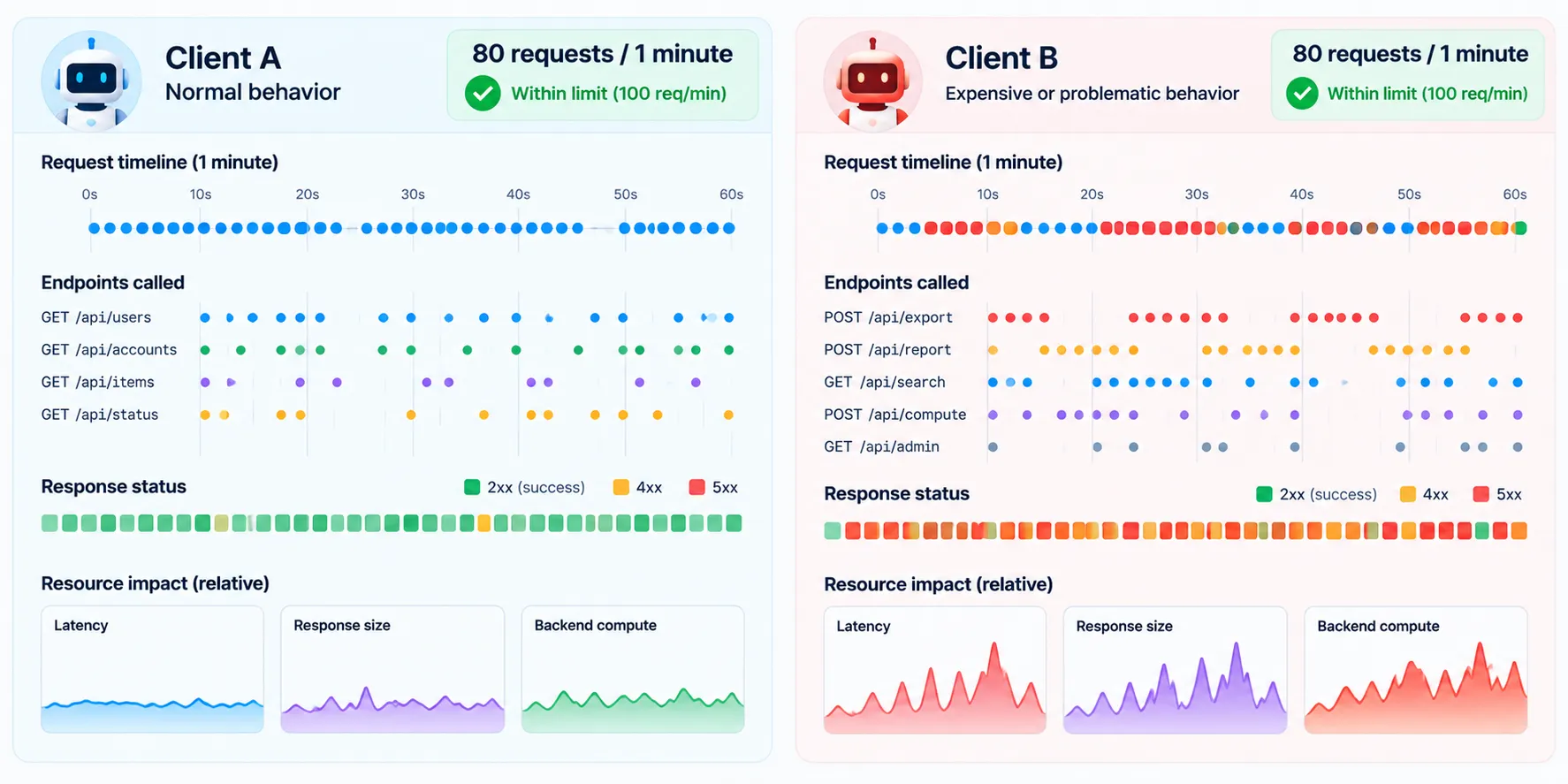
Consider two authenticated API consumers using the same service. Both are subject to a limit of 100 requests per minute. Both consistently send 80 requests per minute.
Consumer A performs ordinary lightweight reads across the endpoints expected for its workflow. Requests succeed, response sizes remain modest, and the sequence resembles its normal usage.
Consumer B also sends 80 requests per minute, but its activity looks different. It might repeatedly invoke an expensive reporting operation, generate an unusual concentration of failures, or execute a machine-driven sequence that differs substantially from its established pattern.
From the perspective of the configured request-count threshold, both consumers are compliant.
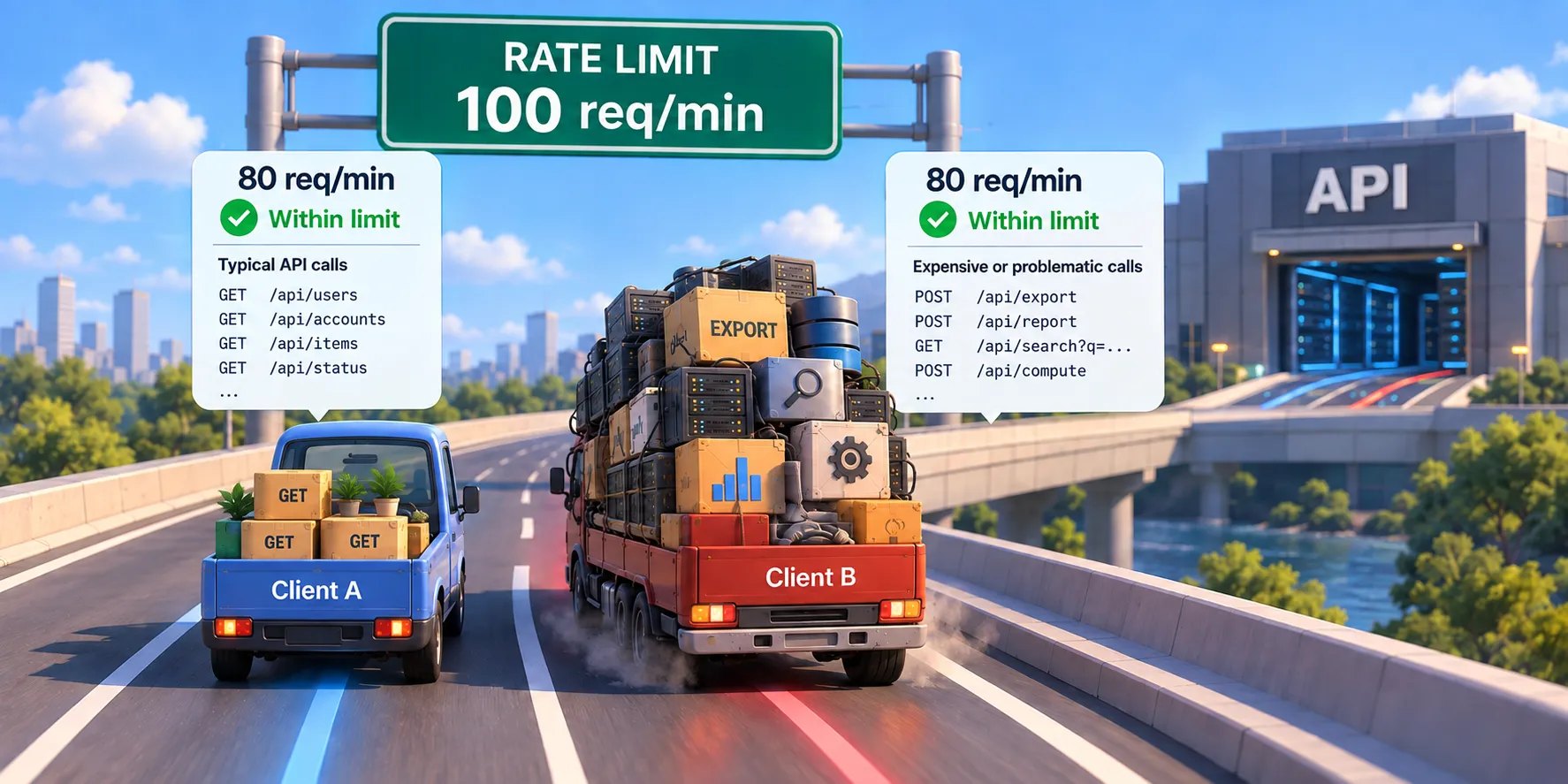
Consumer B is not necessarily malicious. Its behavior could result from a software defect, a poorly configured integration, an automated workflow, a retry loop, or legitimate use of an unusually expensive feature. The important distinction is narrower:
Threshold compliance does not establish that behavior is safe or operationally inexpensive.
Authentication does not resolve this distinction either. Authentication establishes whether a consumer can present acceptable credentials. Authorization determines what that consumer is permitted to access or perform. Neither, by itself, describes how the consumer behaves after access has been granted.
Rate limiting adds another useful dimension: how frequently the consumer acts. But rate and behavior are not the same thing.
Behavior can include which endpoints a consumer selects, the order in which it calls them, how broadly it traverses the API, how often requests fail, how much data it transfers, how much backend work its requests trigger, how aggressively it retries, and whether those characteristics change over time.
A static threshold does not need to capture all of this to remain valuable. Its strength comes partly from its simplicity. The problem arises when that simplicity is treated as a complete representation of runtime risk.
What Request Counts Cannot See
Request count describes volume. It does not describe the work behind those requests, their sequence, or their effect on the system.
Consider an API that serves both cached reads and data exports. One consumer might perform 1,000 cached reads with little backend work, while another performs 20 exports that trigger database queries, aggregation, serialization, and large data transfers. Request count makes the first workload look 50 times larger. Resource consumption may tell a different story.
Endpoint selection creates another distinction. Sixty requests distributed across the endpoints normally used by an integration differ from 60 requests spread across nonexistent or rarely used routes. The second pattern might indicate route discovery, a broken client, outdated API knowledge, or some other unexpected behavior. The request count cannot distinguish among these possibilities.
Response patterns add more context. A consumer producing mostly successful responses has a different operational profile from one producing persistent 401, 404, 429, or 5xx responses. But an elevated error rate is not automatically evidence of an attack. Authentication failures can result from expired credentials. A deployment can leave clients calling removed routes. Server errors can originate entirely on the backend.
The useful information comes from relationships between signals.
| Signal | What it can reveal beyond request count |
|---|---|
| Endpoint selection | Which operations the consumer is invoking |
| Endpoint distribution | Concentrated use, expected workflows, or broad route traversal |
| Response status | Success, authentication pressure, invalid routes, throttling, or server failures |
| Latency and backend cost | How much work requests cause downstream |
| Bytes transferred | Data consumption that request count may understate |
| Concurrent connections | How much connection capacity a consumer occupies |
| Connection creation rate | Rapid reconnects, bursts, or connection churn |
| Retry behavior | Whether failures cause additional traffic pressure |
| Persistence | Whether unusual activity is momentary or sustained |
| Session occupancy | How long scarce sessions or streaming connections remain active |
| Historical behavior | Whether current activity differs materially from previous behavior |
Retry behavior illustrates why sequence matters. Suppose an API begins returning intermittent 503 responses during a partial service failure. A consumer configured with aggressive retries may immediately repeat failed operations. Each retry adds load to an already constrained service, which can produce more failures and therefore more retries.
The operationally relevant pattern is not simply requests per minute. It is the sequence of failure → retry → failure → retry, combined with timing and backend pressure.
Concurrency creates a similar distinction. Two consumers can generate the same number of requests over five minutes while using very different amounts of capacity. One sends short requests separated by idle periods. Another maintains many long-running requests or streaming sessions simultaneously. Their aggregate request counts can be identical even though their occupancy of connection slots or other constrained resources differs substantially.
Historical context provides another useful dimension. A partner integration that normally calls three endpoints a few times per minute may suddenly begin traversing dozens of routes. A service that usually transfers a few megabytes per hour may begin downloading substantially more. Neither change proves compromise or abuse, but the deviation can matter when evaluated alongside identity, endpoint use, errors, timing, and resource impact.
Static controls can become more specific. An API gateway can enforce different limits by identity, endpoint, operation, or other dimensions. An expensive export endpoint might receive a much lower quota than a cached read endpoint. Such controls address many predictable cases.
The remaining constraint is that predefined controls depend on choosing dimensions and limits in advance. Engineers must decide what to measure, where to apply limits, and what values represent acceptable usage.
That becomes harder when risk depends on combinations and sequences. A high error rate can be harmless. An expensive request can be legitimate. Broad endpoint use can be expected for one consumer and unusual for another. High concurrency can be appropriate for a batch workload. Even a substantial behavioral deviation may simply reflect a new software release.
No single signal necessarily establishes malicious intent. The relevant question is what the signals mean together and over time.
Machine-Speed Consumers Change the Operating Assumptions
This distinction matters increasingly because many APIs are consumed directly by software: partner integrations, background services, workflow automation, scheduled jobs, and AI agents.
These consumers can operate continuously, make decisions programmatically, and initiate the next request immediately after processing the previous response.
This does not make machine-driven consumers inherently unsafe. It changes the operating conditions under which API controls must work.
A human using an application naturally introduces pauses. Software does not unless those pauses are designed into it. An automated consumer can sustain activity for hours, maintain many concurrent sessions, react immediately to failures, or repeatedly execute a valid operation without technically violating authentication or authorization rules.
This makes an important distinction increasingly relevant:
Authentication and authorization establish what a consumer may access. Runtime behavioral controls evaluate what that consumer is actually doing after access is granted.
This distinction is explored in more detail in Behavior After Access: Adding Runtime Behavioral Security to the API Stack.
Consider a partner integration with valid credentials. A software update introduces faulty retry logic that retries immediately whenever an upstream request times out. During normal operation, the defect may be invisible. During a partial outage, however, the integration can begin generating additional requests precisely when the backend has the least capacity to process them.
The integration remains authorized. It is not necessarily under attack, and the partner is not necessarily behaving maliciously. The problem is runtime behavior: a malfunctioning client is amplifying operational pressure.
Runaway automation creates a related problem. A workflow might be designed to fetch a record, process it, update its state, and terminate. A bug prevents the terminal state from being recorded, causing the workflow to repeat. Every individual API operation can be valid. The sequence as a whole is not behaving as intended.
AI agents introduce another version of the same issue. An agent may be authorized to invoke a search tool, generate a report, query a database-backed endpoint, or retrieve documents. A planning error or unexpected loop can cause it to invoke an expensive operation repeatedly. Nothing about an individual request necessarily distinguishes it from legitimate use.
The relevant signals might instead be persistence, repetition, accumulated backend cost, concurrency, or a sudden change from the agent’s previous behavior.
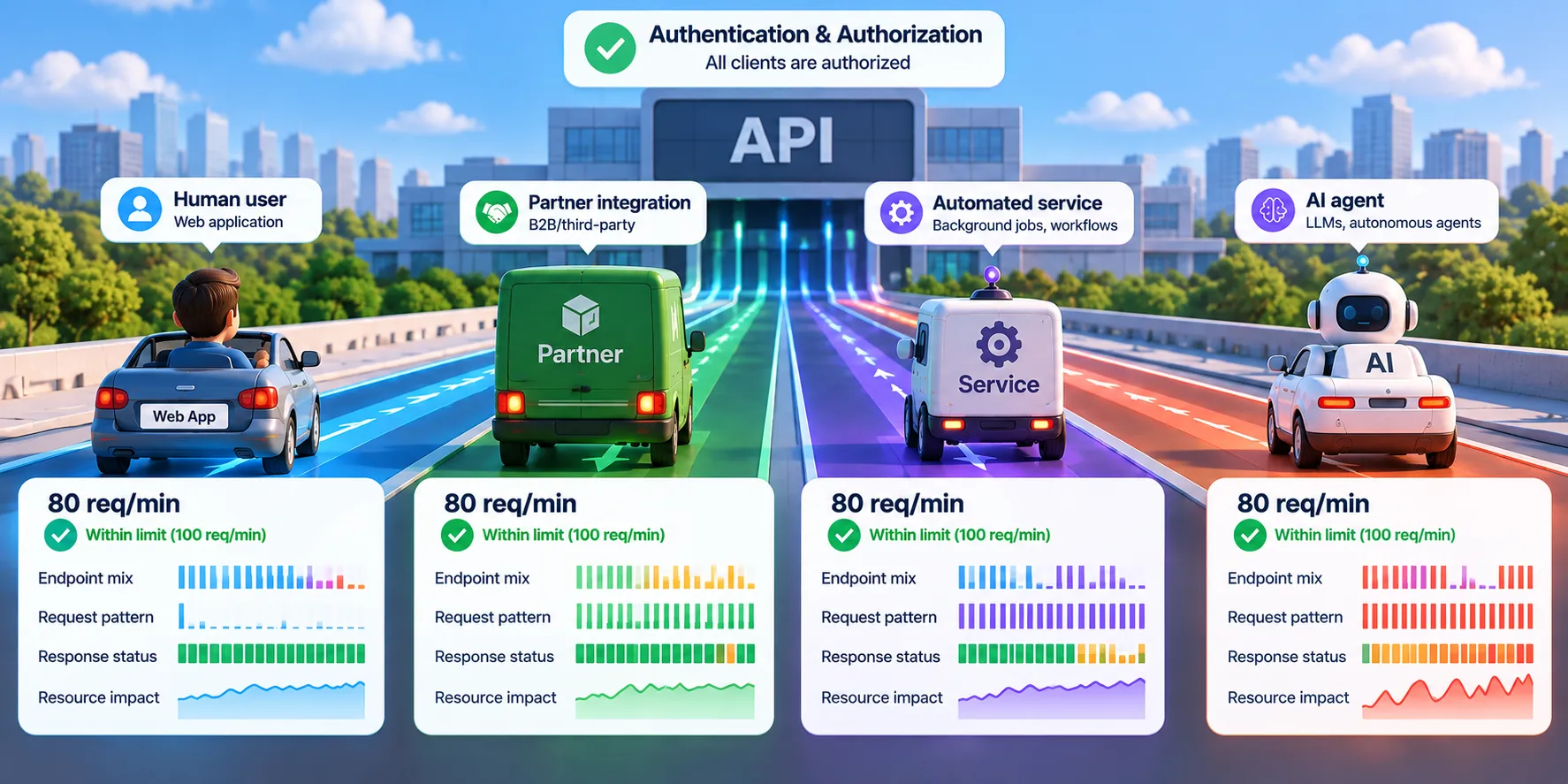
Long-lived connections and sessions create similar challenges. An automated consumer may remain within a reasonable request rate while opening many concurrent sessions or holding scarce sessions open for long periods. For APIs supporting streaming responses or persistent MCP sessions, session occupancy may matter more than requests per minute.
Data retrieval provides another example. A consumer can be fully authorized to read a dataset yet retrieve it at a volume or persistence that violates an organization’s operational or usage policy. This could result from a legitimate bulk-processing job, an incorrectly configured crawler, an AI application consuming more data than expected, or deliberate data harvesting. Authorization alone cannot distinguish among these cases.
Nor does high volume necessarily imply high impact. Thousands of inexpensive cached requests can consume fewer resources than a much smaller number of database-intensive operations.
Conversely, a machine-driven consumer can create sustained pressure while remaining just below a configured threshold. A policy that permits 1,000 requests every five minutes will consider 950 requests compliant. Sustaining that rate all day might be normal for one consumer and a significant behavioral change for another whose historical activity is much lower.
Operating near a threshold does not make the consumer malicious. It illustrates that threshold compliance and acceptable runtime behavior answer different questions.
From Static Thresholds to Behavioral Evaluation
The natural extension of static rate limiting is not to discard thresholds, but to give runtime decisions more context.
A conventional rate policy asks:
“Has this consumer exceeded a configured threshold?”
Behavioral runtime evaluation adds another question:
“Does the measured campaign of requests from this client appear to be a threat?”
Here, campaign does not imply malicious intent. It describes accumulated activity associated with a source, identity, client, or other policy subject across multiple requests and over time. A campaign might represent normal application behavior, a malfunctioning integration, unexpected automation, a policy violation, or an attack.
The distinction matters because individual requests often provide too little information to characterize what is happening.
A request to /api/export may be legitimate. Ten such requests may also be legitimate. But repeated exports combined with increasing response size, unusual persistence, rising concurrency, and a substantial departure from the consumer’s previous activity provide a different operational picture.
Behavioral runtime evaluation maintains context across requests so that policy can consider relevant observations together. That context can include identity or source, endpoint selection, request rate, response status, latency, bytes transferred, concurrent connections, connection creation rate, route spread, retry behavior, persistence, and resource impact.
Not every policy needs every signal. The point is to avoid forcing one counter to represent conditions that depend on several dimensions.
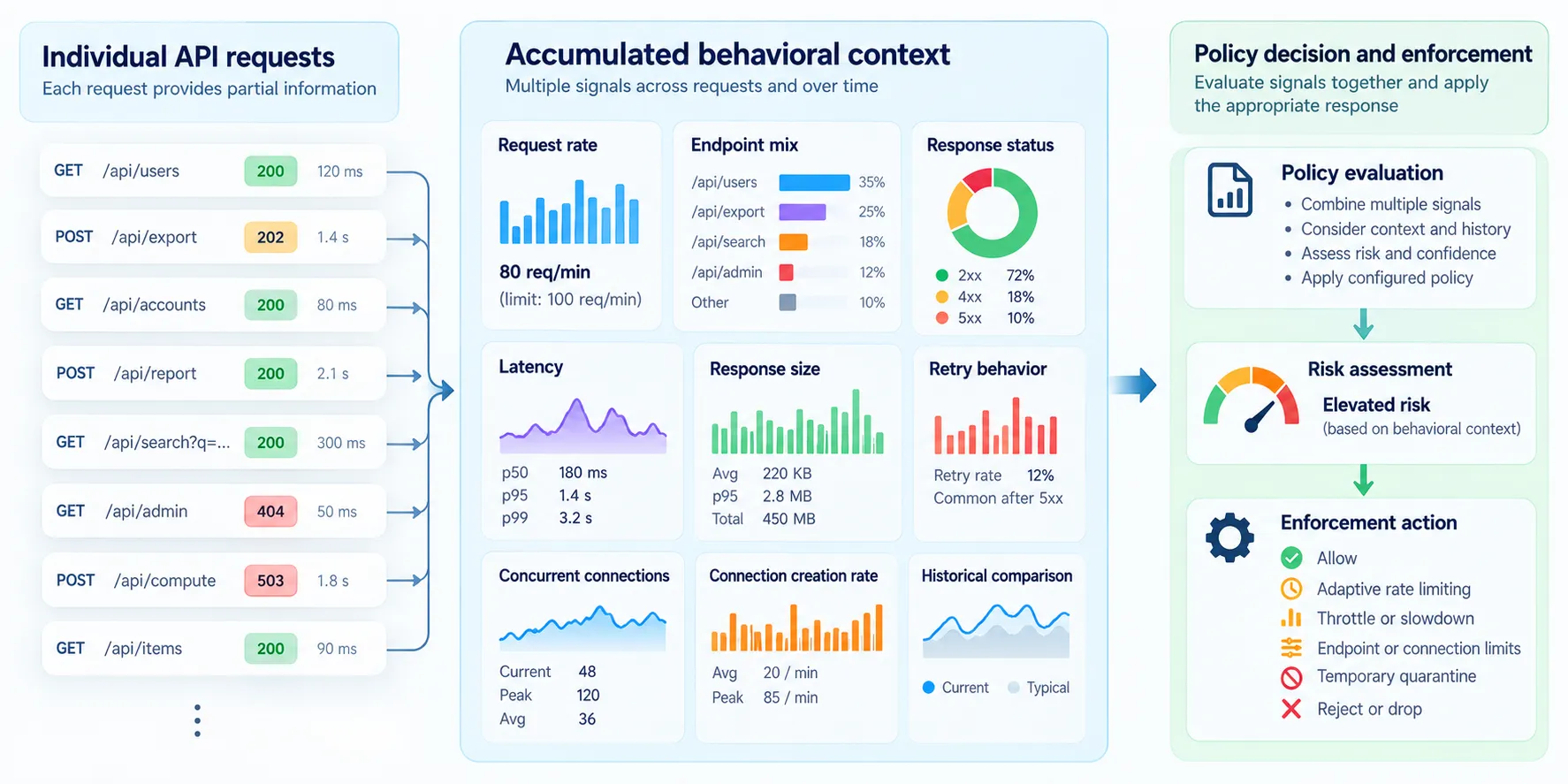
This also separates detection signals from enforcement decisions.
An elevated error rate is a signal. High concurrency is a signal. A deviation from previous behavior is a signal. None determines an enforcement action by itself. Policy determines how observations should affect traffic.
Static thresholds remain part of this model. An API may still enforce 100 requests per minute on an endpoint while also tracking failures, latency, bytes, retries, or concurrency. A behavioral policy might use the rate threshold as one input, apply a separate endpoint-specific limit, or change enforcement when several signals occur together.
Proxyble implements this type of behavioral runtime layer. It analyzes API traffic and behavioral patterns in real time, maintains context across requests, detects attacks, abuse, anomalies, and policy violations, and can apply configured runtime enforcement.
For environments where this analysis must remain inside private infrastructure or operate without external connectivity, see Behavioral API Security Without Sending Your Traffic Outside Your VPC.
Its role is complementary to the surrounding API infrastructure. Authentication and authorization continue to establish access. API gateways can continue routing traffic and enforcing quotas. WAFs and CDNs can continue applying their respective controls. Observability and SIEM systems can continue collecting telemetry and supporting investigation.
The architectural change is narrower: request rate becomes one part of the behavioral picture rather than the entire picture.
Behavior-Informed Control in Practice
The difference becomes clearer when similar request rates produce different operational conditions.
| Scenario | Static counter sees | Behavioral context adds | Possible response |
|---|---|---|---|
| Retry storm | Request volume, possibly still within quota | Failures followed by rapid retries, persistence, rising connection pressure | Slow requests, reduce effective rate, temporarily deflect traffic |
| Expensive endpoint use | Ordinary request count | High latency, timeouts, compute cost, large responses | Endpoint-specific limits, shorter timeouts, bandwidth constraints |
| Gray-zone automation | Consumer remains below configured threshold | Persistent near-limit activity, little idle time, accumulating bytes or cost | Adaptive throttling or gradual slowdown |
| Discovery or scraping | Moderate request volume | Route spread, error ratios, traversal patterns, successful reads, bandwidth | Restrict rate, collect evidence, reject or block when confidence warrants |
Retry storms
Suppose a legitimate integration normally sends a steady stream of requests. The backend begins experiencing a partial failure and responds intermittently with 503 errors. The client immediately retries failed operations.
A request counter sees an increase in traffic. If the configured quota is generous, the integration may remain below it. If the quota is tighter, the consumer may eventually cross the threshold and receive 429 responses—which poorly designed retry logic may treat as another reason to retry.
The more informative pattern is temporal: requests fail, retries follow immediately, failures continue, and the cycle persists while the service is already under pressure.
Proxyble’s Retry Storm Control can evaluate this combination rather than relying only on aggregate volume. The appropriate response does not have to be a ban. A temporary slowdown, reduced effective rate, or busy response can reduce amplification while allowing the backend time to recover.
Expensive endpoint use
Request count can also misrepresent cost.
An authenticated consumer might make relatively few requests to endpoints that generate reports, execute complex searches, export data, or trigger expensive backend processing. Its overall request rate looks ordinary, yet its requests consistently produce high latency, large responses, timeouts, or substantial compute work.
A static quota remains useful, and an endpoint-specific limit can address known expensive operations. Behavioral context adds the ability to consider what is happening across the consumer’s activity: which endpoints it selects, how frequently it returns to them, the latency associated with those requests, response sizes, failures, and how long the pattern persists.
Proxyble’s Expensive Endpoint Cost Control addresses this type of pattern.
An expensive workload may be entirely legitimate. Rather than blocking it, policy might constrain its endpoint rate, shorten backend timeouts for that source, or limit response bandwidth. The objective is to control resource impact without treating cost alone as evidence of abuse.
Gray-zone automation
Static thresholds create known boundaries. Automated consumers can operate below those boundaries for long periods.
Consider a consumer that remains close to its configured request limit throughout the day. It rarely exceeds the threshold, so threshold-based enforcement rarely activates. But it also shows little idle time and continuously accumulates response bytes, backend work, or connection occupancy.
This pattern differs from both a short legitimate burst and an obvious flood.
Proxyble refers to this class of behavior as Gray-Zone Automation Shaping. The relevant evidence comes from persistence combined with resource consumption: sustained request activity, limited idle periods, accumulated bytes or cost, and potentially other signals such as concurrency.
The consumer could be a crawler, batch process, partner integration, AI agent, or simply inefficient software. That uncertainty is one reason proportional control matters. Policy can gradually reduce its effective rate, introduce slowdown, or constrain the resource it is consuming rather than immediately rejecting it.
Endpoint discovery and scraping
Moderate request volume can also conceal meaningful differences in where requests go.
One consumer might make successful reads across a small, expected set of resources. Another might issue the same number of requests across dozens of unrelated or nonexistent routes, producing elevated 400, 404, or 405 responses. A third might systematically traverse valid content and accumulate a large volume of response data.
Aggregate rate alone does not resolve those cases. Route spread, method selection, status distribution, traversal sequence, successful-read volume, persistence, and bytes transferred provide a richer description.
Proxyble’s Endpoint Discovery Control and Scraping and AI Crawler Cost Control use these kinds of signals to evaluate such patterns.
Ambiguous activity may justify monitoring and evidence collection. Persistent costly behavior may justify throttling or bandwidth limits. High-confidence hostile probing may justify rejection or blocking.
The common principle is that runtime evaluation becomes more informative when it measures what traffic is doing, not merely how much traffic exists.
That still leaves an operational question: what should happen once the system has enough context to act?
Enforcement Should Be Graduated, Not Binary
Richer detection does not require more aggressive enforcement. In many cases, it enables a narrower response to the specific behavior creating risk or pressure.
A binary model offers two basic states: allow the traffic or block it. That can be appropriate when policy is unambiguous, but many runtime situations contain uncertainty. A consumer may be malfunctioning rather than malicious. An unusual workload may be legitimate. A sudden burst may be temporary. A costly operation may be permitted but consuming more resources than the service can safely provide.
Behavioral evaluation therefore needs to distinguish detection confidence from response severity. Observing a suspicious pattern does not automatically determine what should happen next. Configured policy determines which enforcement actions are available and under what conditions they apply.
At the lowest level, the appropriate response may simply be to observe. Proxyble can collect evidence and alert operators while allowing traffic to continue.
As evidence accumulates or operational impact increases, policy can introduce pressure gradually.
A retry storm, for example, may warrant LIMIT RATE SLOW to return rate-limit responses or BUSY DEFLECTION to indicate temporary service pressure. The goal is to reduce amplification, not to classify the client as hostile.
Expensive operations call for different controls. LIMIT ENDPOINT RATE can constrain a costly operation without unnecessarily restricting unrelated API use. If large responses are the primary concern, LIMIT BANDWIDTH can reduce output pressure. If requests are taking too long and consuming backend resources, TIMEOUT can shorten how long backend requests for that source may wait.
For a detailed example of combining endpoint, tenant, and behavioral context around expensive operations, see Protecting Expensive API Endpoints with Per-Tenant Controls.
Connection-heavy behavior requires another response. A consumer rapidly creating connections can be constrained with LIMIT CONNECTION RATE. A consumer holding too many connections or long-lived sessions simultaneously can instead be subject to LIMIT CONCURRENT CONNECTION.
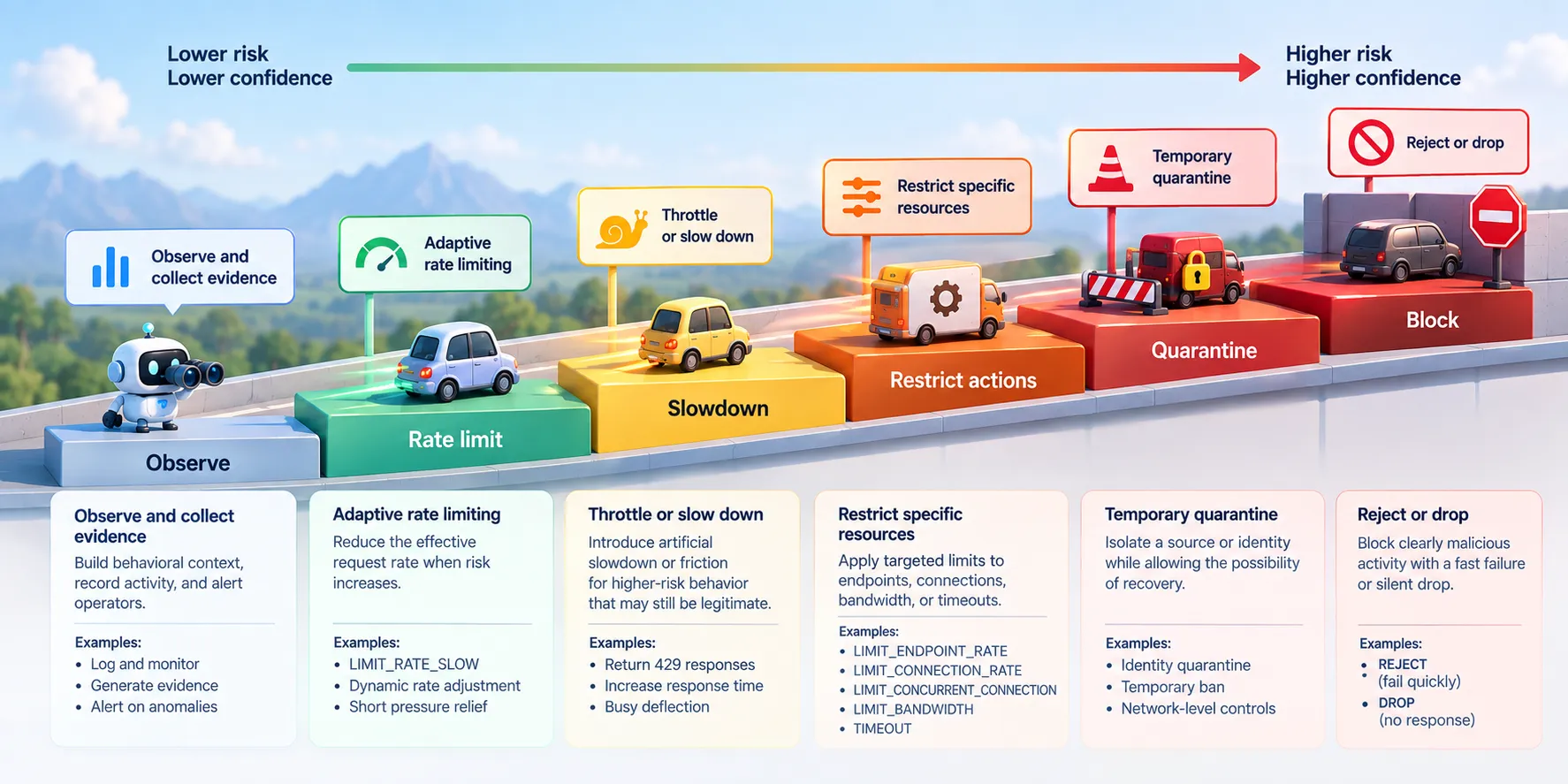
These controls fit within a broader progression. Depending on configured policy, Proxyble can move from alerting and evidence collection to adaptive rate limiting, throttling, artificial slowdown, action restrictions, identity quarantine, temporary bans, network-level controls, and blocking clearly malicious activity.
Stronger intervention becomes appropriate when evidence and policy justify it. A source producing clearly unwanted requests may receive REJECT, which fails traffic quickly. Traffic classified with sufficient confidence as hostile can be handled with DROP, which silently discards it.
These actions solve different problems. Bandwidth limiting addresses data-transfer pressure. Concurrency limits address resource occupancy. Endpoint limits constrain a particular operation. Temporary quarantine can isolate an identity while preserving the possibility of recovery. Rejection or dropping is appropriate when policy determines that continued interaction has little value.
Proxyble does not need to infer an organization’s business intent to make that distinction. Configured policies define which observations matter, what combinations justify intervention, and which actions are permitted. Different organizations—and different APIs within the same organization—can make different decisions from similar telemetry.
Static rate limiting therefore remains part of enforcement. It simply becomes one mechanism among several that can be selected according to the behavior being controlled.
A Layered Model for Runtime API Control
What comes after static rate limiting is not the removal of rate limits. It is a broader runtime model in which request rate remains important without being asked to represent every form of API risk.
The layers answer different questions.
Authentication and authorization establish permitted access. They determine whether a consumer can identify itself and which operations it is allowed to perform.
Static limits establish predictable boundaries. They enforce quotas, protect known capacity constraints, and provide clear limits on request frequency.
Behavioral runtime evaluation measures what happens after access is granted. It considers activity across requests and over time: which endpoints a consumer uses, how requests are distributed, whether failures trigger retries, how much data is transferred, how resources are occupied, and whether behavior changes materially.
Policy interprets those observations. No single error, expensive request, behavioral deviation, or period of high activity necessarily indicates an attack. Significance comes from context, combinations of signals, persistence, and the operating conditions of the API.
Enforcement applies the configured response. Depending on risk, confidence, and operational impact, that response can range from observation to resource-specific constraints to stronger intervention.
Evidence gives operators context for reviewing decisions. Runtime controls are more useful when engineers can examine the behavior and policy conditions behind an action rather than seeing only that a threshold was crossed.
Proxyble implements the behavioral runtime layer in this model. It sits alongside existing API infrastructure, maintaining context across traffic and applying configured policies as behavior develops. It does not replace authentication, API gateways, WAFs, CDNs, observability systems, SIEMs, or service meshes. Those systems continue to perform their respective functions; behavioral runtime evaluation adds another control point concerned with what consumers actually do.
This layered architecture avoids a false choice between simple and sophisticated controls. A fixed quota may be exactly the right mechanism for a known API boundary. An endpoint-specific rate limit may be sufficient for a predictable expensive operation. Behavioral evaluation becomes useful when the relevant condition cannot be represented adequately by one predefined counter.
The shift is therefore not from static controls to dynamic controls, or from rate limiting to a universal replacement. It is from treating request rate as the primary representation of API activity to treating it as one signal within a larger behavioral context.
A modern API control system still needs to know how many requests a consumer makes. It increasingly also needs to evaluate what those requests collectively do.